
The Soul of the Craft: Why Traditional Arts Matter
Life rarely works out exactly the way we want. We face resistance in our careers, our education, and our homes, constantly struggling to make sense of a persistent chaos. Even when we finally strike a balance, it is often offset again before we can truly settle into it. Yet, this very struggle is where our value as humans lies.
Our world depends on our actions. When we neglect this struggle, we waste our most unique ability: the potential to create harmony and beauty out of an utter mess.
Artisans as Companions to Nature
No human activity expresses this balance quite like traditional vocations. Authentic crafts are not simply about mastering technical skills; they are about a relationship with nature. The artisan acts as a companion to their materials, working in ways that are consistent with the nature of the wood, stone, or clay.
Contrast this with the automated, modern modes of production that rely on plastics and synthetics. Unlike mass-produced objects, traditional crafts offer an art form that is consistent with human nature and our deeper needs.
More Than a Job: A Path of Ihsan & Excellence
Before the modern era, work was rarely a “9 to 5” occupation. It was a vocation that encompassed one’s entire social life. In cities like Cairo, members of the same craft lived in the same quarters (hara), bound together by strong community ties and a code of chivalry (futuwwa).
These social ties were not merely for practical convenience. They existed because the transmission of a craft was about more than just technique. It was about the cultivation of the soul (nafs). Under the guidance of a master, an artisan did not just work on an object; they also worked on their own character, refining their “lowest tendencies” like haste, negligence and impatience (all coming out of al-hawa (caprice) and shahwa (desire). As René Guénon suggested, when a craft is suited to a person’s nature, it reaches the heart, leading to a path of ihsan (character refinement). This ihsan is then mirrored in the craft.
Traditional Art & Architecture as a Reminder of the Divine
Modern cities are filled with high-rise towers and luxurious buildings that manipulate nature standardising facades, cutting down trees, and redirecting rivers – the list goes on. These structures give us the false impression that our abilities are unlimited. This mindset has placed man as the centre of the universe, instead of the Divine.
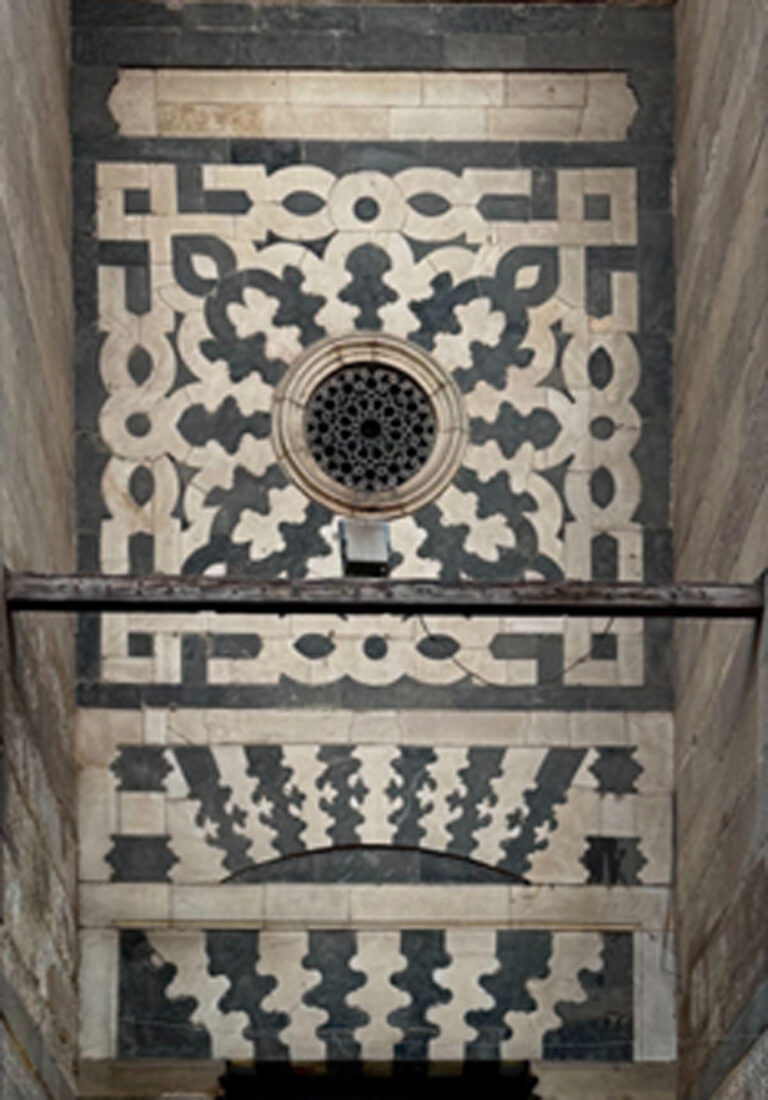
In contrast, the traditional city offers constant reminders of our limits through its art and built environment.
Consider al-Ablaq, the pattern of joggled black and white marbles found in mosques and palaces alike. This pattern refers to the inevitable succession of good and evil, day and night, contraction (qabd) and expansion (bast).
(al-Ablaq pattern from the portal of al-Sultan Because life is transitory, art must serve as a reminder of the eternal.
From Raw Matter to a Mirror of the Truth
Without the artisan, matter remains indistinct and its beauty stays hidden. An artisan begins with a raw, formless substance like a block of wood or a pile of clay. In its primary state, it is chaotic and lacks distinction, yet it possesses the potential to become a masterpiece.
The artisan’s role is to bring that potential to its fullest. By applying traditional proportions and techniques, the craftsman gives identity to the material. By respecting the nature of the substance (e.g. the wood or clay), the craftsman accepts their role, not as a “creator,” but as a mirror of Truth. A master artisan then fashions a door or a carves copper to make a candle holder.
(Picture of joinery door) and (copper candle holder)
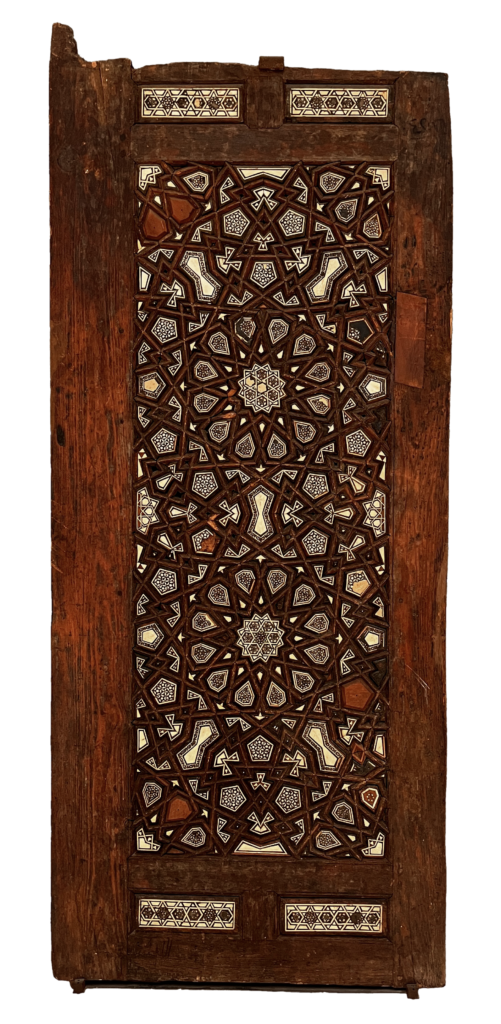
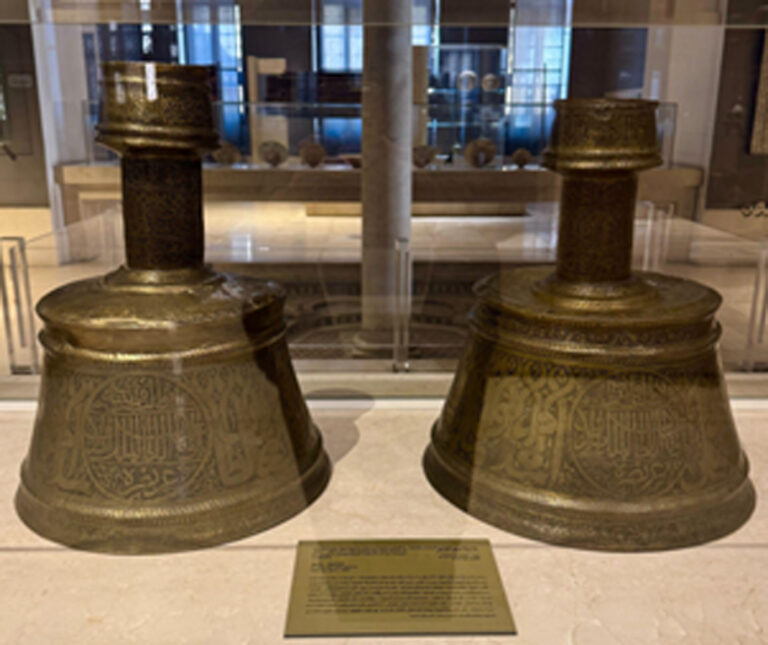
This process of transforming undifferentiated matter into a masterpiece corresponds to our creation. Until we encounter life, with its qabd and bast, our potential remains hidden. Our real character is chiseled through hard and good times.
Why We Choose the Handcrafted
Despite the rapid changes of the modern world, traditional crafts still hold the seeds of the past. They require a level of skill, patience, care and knowledge that machines cannot replicate.
Traditional crafts matter because they cultivate both the world and the soul. Unlike industrial production, craftsmanship transforms raw material in a way that reflects human limits and spiritual discipline. When we bring these objects into our lives, we are not just acquiring a product; we are surrounding ourselves with reminders of truth, order, and our unique place within creation.
To see how these principles of order and beauty take shape, I invite you to explore Iwan Jameel’s handmade collection. Find a piece that resonates with your own understanding of balance and beauty.

Mohamed A El-Gendy
is a sociologist by training. He holds two masters degrees in international politics from the University of Bradford and political sociology from the University of Cambridge and a PhD (ABD) in sociology from the University of Cambridge. El-Gendy wishes to serve as a bridge between modern society and traditional science of society and urbanism (‘ilm al umran) by writing and speaking on sacred art and architecture. You can follow him on Instagram @m.a.gendy